The landscape of software engineering is undergoing its most radical transformation since the transition from machine code to high-level programming languages. With the explosion of advanced AI coding tools, a fundamental shift is occurring in how software is conceived, built, and maintained.
In the Google Whitepaper, The new SDLC with vibe coding, this shift is summarized as follows:
"A new paradigm has arrived in which developers express what they want to build rather than how to build it. The machine handles implementation. The human provides intent, architecture, and judgment. This isn't a distant future - it's the daily reality for a rapidly growing number of professional developers. As of early 2026, 85% of professional developers regularly use AI Coding Agents, 51% use them daily, and an estimated 41% of all new code is AI-generated."
Under this new software development lifecycle (SDLC), writing code is no longer the bottleneck. Instead, architectural design and governance have emerged as the defining pillars of successful software delivery.
The New SDLC: Coder to Architect
When AI handles the implementation details (the how), the human engineer’s primary role transitions into that of a supervisor, a system designer, and a judge (the what).
This presents unique challenges:
- Context Drift: AI coding agents have no historical memory. They analyze your immediate files, but do not know the reasoning behind database selection, modular boundaries, or service layouts.
- Spaghetti Architecture: If left unchecked, autonomous agents write functional code that achieves the task but introduces severe architectural drift. They might bypass API gateways, make direct database calls from frontend hooks, or introduce circular dependencies.
- The Blank Canvas Problem: Explaining a complex, multi-service topology through text prompts alone is slow and highly prone to misinterpretation by LLMs.
To prevent this drift, organizations need a way to define, communicate, and enforce system boundaries in a machine-readable format.
Enter FloDraw: The Architectural Governance Layer
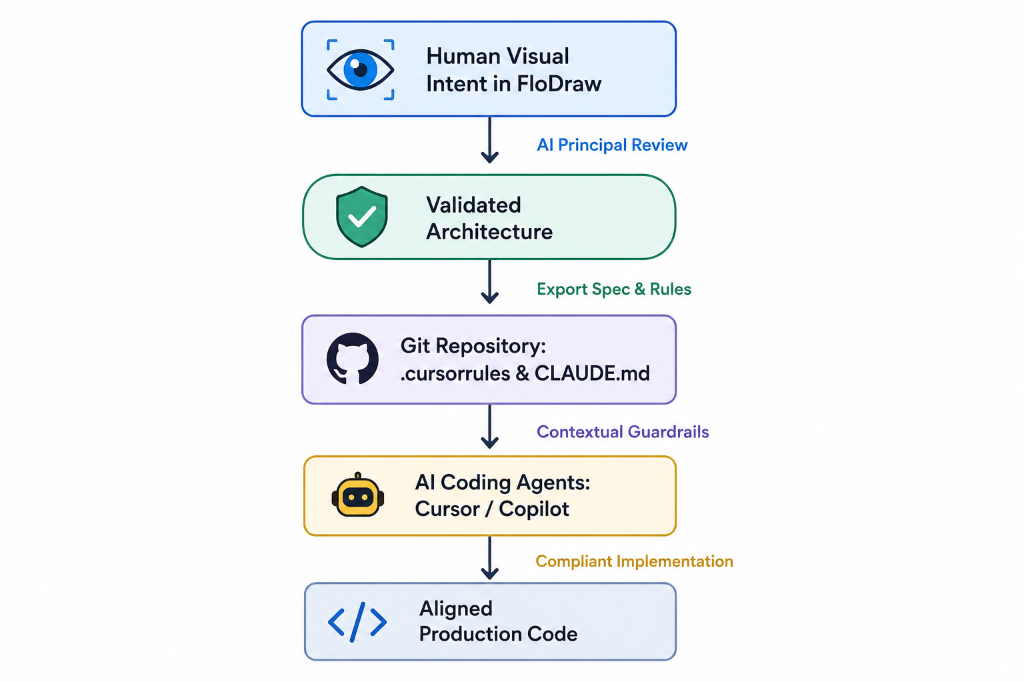
This is exactly where FloDraw fits into the new SDLC. Rather than forcing you to write pages of static text or let AI guess your topology, FloDraw gives every product a workspace — vision, PRD, architecture, and decision records in one connected place — and bridges that design directly into executable code.
1. Visualizing Intent
FloDraw provides a drag-and-drop infinite canvas with AWS and GCP icon libraries, and smart orthogonal routing. By designing visually, you express your system architecture in seconds.
2. AI Principal Reviewer (Real-time Governance)
Before your design goes to code, FloDraw's built-in Principal Architect runs automated checks on security, scale, and compliance (e.g. AWS Well-Architected Reviews). It points out single points of failure, unencrypted databases, or incorrect routing before implementation starts.
3. Exposing Architectural Context to AI Coders
Once approved, FloDraw compiles your diagram into executable .agents/ configurations (spec.json and AGENTS.md rulesets) along with styled markdown design specs.
These files are committed directly to Git. When your AI agent (like Cursor, Claude Code, or Antigravity) indexes the repository, it instantly reads the architectural guardrails, ensuring that all auto-generated code respects your designed boundaries.
4. The Workspace as the Agent's Brief
Guardrails answer "what am I not allowed to do?" — but agents also need to know why the system exists. A FloDraw workspace holds the vision, PRD, and ADRs beside the architecture — export it straight into your repo as a Handoff bundle (live MCP access is coming), and every agent session starts with full product context instead of a blank slate and a re-explanation.
Conclusion
As AI coding agents become the primary engine of software execution, software architecture has reclaimed its crown. Code is cheap and disposable, but system design and boundaries are permanent.
By using FloDraw as your architectural governance layer, you get the best of both worlds: the accelerated speed of AI-driven coding, with the safety, scalability, and long-term maintainability of expert system architecture.
Ready to design your next system? Start Designing with FloDraw today.