Show an executive a microservices diagram and watch their eyes glaze over. Show them a business capability map — clean layers, from what customers touch down to the platform that keeps the lights on — and suddenly everyone's leaning in, pointing at boxes, and having the strategy conversation you actually wanted to have. 🎯
Capability maps are the lingua franca of enterprise architecture: they describe what the business does, not how the servers talk. They're how you decide where to invest, what to modernize, and — increasingly — where AI should be applied first. Every AI transformation roadmap starts with someone asking "which of our capabilities does this touch?"
There's just one snag: making one has traditionally meant a week of PowerPoint archaeology, wrestling with alignment guides and rounded rectangles. FloDraw fixes that.
Layered Diagrams: Capability Maps as First-Class Citizens
FloDraw's layered diagram support renders capability maps the way they're meant to look: stacked, color-themed capability layers, each holding a grid of neatly iconed capability cards, with flow arrows connecting adjacent layers.
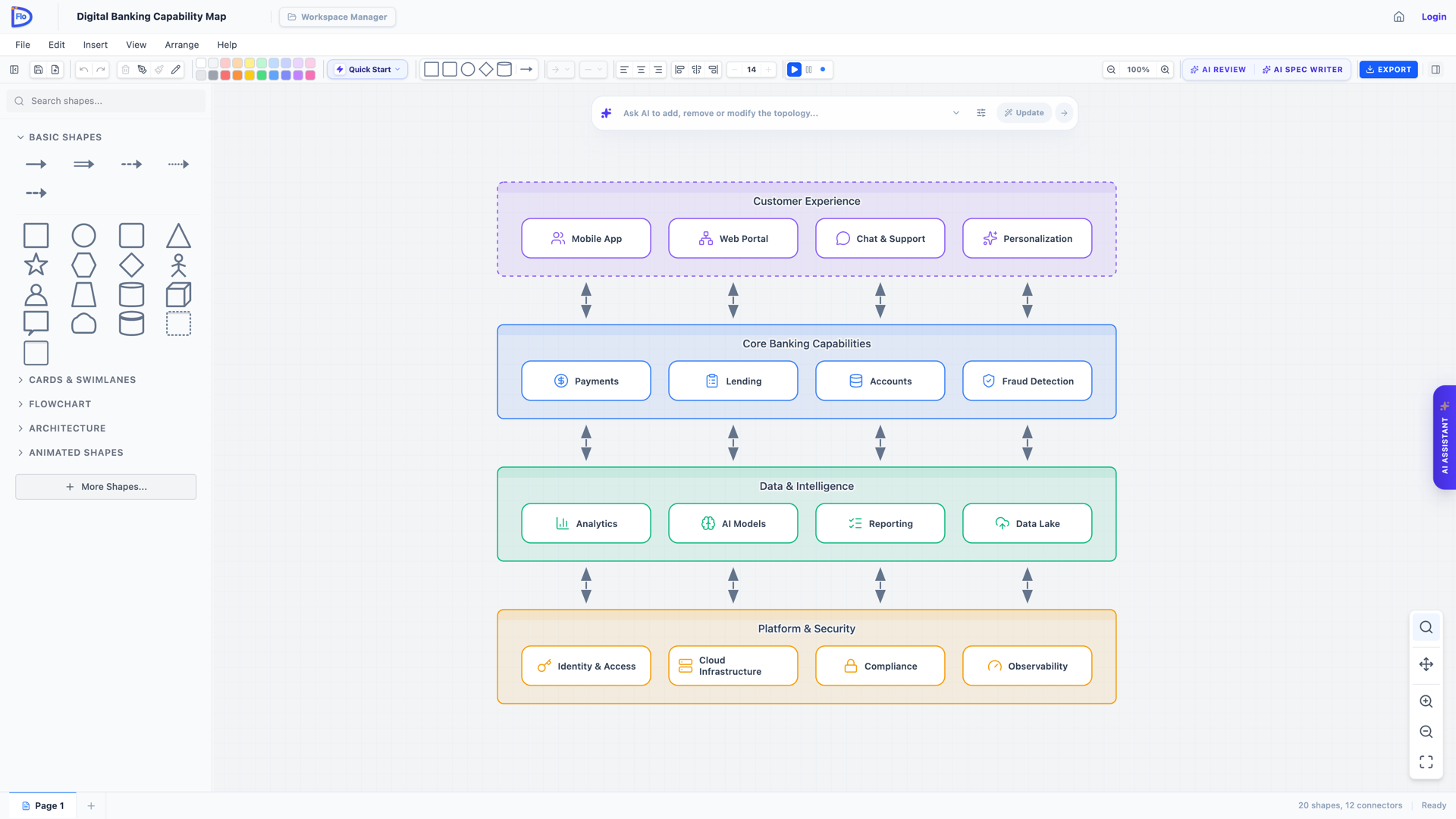
✏️ Try it yourself: open this capability map in FloDraw — rename layers, drag cards, make it yours. Free, no sign-up needed.
The best part? You don't place a single box by hand. Type a prompt like:
"Create a capability map for a digital banking platform: customer experience layer, core banking capabilities, data & intelligence, and platform & security."
…and FloDraw's AI generates the whole thing — layers, cards, icons, color themes, arrows — perfectly aligned, in seconds. Every element is a real, editable shape: rename a capability, drag a card between layers, restyle a band, or ask the AI to "add an Open Banking APIs capability to the core layer" and watch it re-flow.
Three Ways Teams Are Using It
1. The AI-Readiness Heatmap 🔥
Planning your GenAI rollout? Generate your capability map, then talk through it layer by layer: which capabilities are AI-ready, which are blocked by data quality, which shouldn't be touched. Because every card is an editable shape, color-coding the map into a heatmap takes minutes — and the result is the slide the steering committee remembers.
2. Rescuing Maps Trapped in Old Decks 🖼️
Most organizations already have a capability map… as a PNG in a 2019 strategy deck. Paste that image into FloDraw and hit the Magic Wand — the vision AI recognizes layered layouts specifically and reconstructs them as a proper layered diagram, not a soup of generic boxes. Your legacy map is suddenly alive and editable again.
3. From Business View to Build View 🏗️
Because your capability map lives in the same canvas as your architecture diagrams, it doesn't stop at strategy. Zoom into a capability, design the system behind it, run an AI architecture review, then hand the design to your AI coding agents as compiled rules and specs. Strategy to shipped code, one tool, no re-drawing.
What Makes a Great Capability Map (Cheat Sheet) 📋
Whether you draw it or prompt it, the classics still apply:
- Layers describe stability, not org charts. Customer-facing capabilities change fast; platform capabilities change slow. Top to bottom = fast to slow.
- Cards are nouns, not projects. "Payments", not "Payments Modernization Q3".
- Three to five layers. More and it's an inventory, not a map.
- Icons earn their place. A good icon per capability makes the map scannable from the back of the room — FloDraw's AI picks them automatically.
Make One Right Now
Open FloDraw, tell Studio your industry, and ask for a capability map. Two minutes from now you'll have the diagram that used to take a week — and a canvas where it can keep evolving alongside your architecture, your reviews, and your AI agents. 🚀
The organizations winning the agentic era aren't just automating tasks — they're the ones who can see their business clearly enough to know where automation belongs. Start with the map. 🗺️