Retrieval-Augmented Generation (RAG) has become the industry standard for grounding Large Language Models (LLMs) with private organizational data. However, moving a RAG application from a local prototype (like a basic LangChain script) to a secure, scalable, production-grade cloud architecture requires careful system design.
In this article, we outline a modern, production-ready reference architecture on AWS.
Architecture Topology
A robust enterprise RAG system is split into two distinct pipelines: Ingestion (offline) and Retrieval/Inference (online).
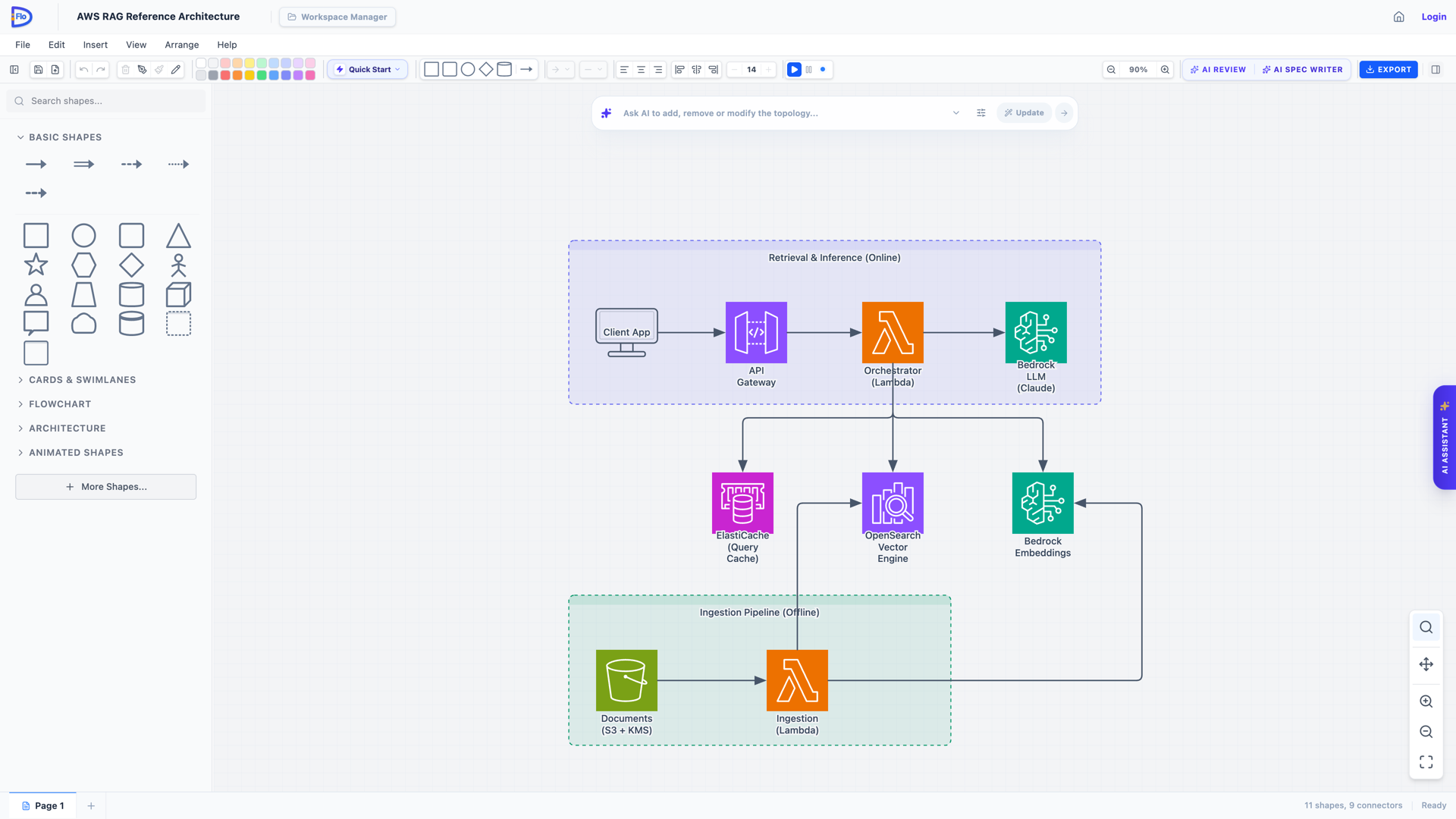
✏️ Try it yourself: open this RAG architecture in FloDraw — fully editable, free, no sign-up needed.
1. The Ingestion Pipeline (Offline)
- Data Source: Documents are stored in a secure Amazon S3 bucket (with KMS encryption enabled).
- Processing Stage: An AWS Lambda function or Amazon ECS Fargate task is triggered upon new document upload. It reads the file, extracts text, chunks it, and calls the embedding model.
- Embeddings Model: AWS Bedrock (e.g., Titan Embeddings or Cohere Embeddings) converts the text chunks into high-dimensional vector representations.
- Vector Database: Amazon OpenSearch Serverless (Vector Engine) stores the document chunks along with their vector embeddings for similarity lookup.
2. The Retrieval & Inference Pipeline (Online)
- API Entrypoint: Clients connect securely to an Amazon API Gateway, which forwards user prompts to a central orchestration service.
- Orchestrator: An AWS Lambda function (or ECS container) handles the query logic:
- Calls AWS Bedrock to embed the user's search query.
- Queries Amazon OpenSearch Serverless using k-NN (k-nearest neighbors) to retrieve the top $N$ most relevant document chunks.
- Formulates a final prompt combining the original user query and the retrieved context chunks.
- Calls the core LLM in AWS Bedrock (e.g., Anthropic Claude 3.5 Sonnet) to generate the final, grounded answer.
- Returns the response back to the client.
Key Considerations for Production
- Security & IAM: Keep all vector retrieval and embedding generation within a Private VPC. Embed security policies so that only the orchestrator Lambda has read/write permissions to OpenSearch.
- Cache Vector Searches: For common or identical queries, implement a caching layer using Amazon ElastiCache to reduce Bedrock embedding costs and similarity search latency.
- Chunking Strategy: A poor chunking strategy (e.g. splitting text exactly at 500 characters regardless of paragraph endings) leads to garbage responses. Invest in semantic chunking or overlap-based splitters.
Visualizing & Sharing Your Design
Designing RAG pipelines visually helps align your development team on boundaries, networking constraints, and data flows. Using Flodraw, you can generate this cloud system architecture topology instantly from a simple prompt, validate security rules, and export conformed specifications for your coding agents.